- Unveiling Jesus Christ
- Posts
- The Third Woe

The Third Woe
John Introduces the Third Woe
The ministry of the Two Witnesses in Jerusalem will end with their death and sudden resurrection after 3½ days (Revelation 11:1–14). This ends the Second Woe and the Third Woe comes quickly.
It’s the moment we’ve all both awaited and dreaded—when unprecedented plagues will cleanse the earth. But instead of plagues, angelic voices praise God and His Christ.
In Revelation 11:15–19, John skips the horrors of the Third Woe to introduce Christ’s final victory over Satan. Christ’s Second Coming victory over Satan is the hallmark event of the Third Woe—and here we have the introduction of it.
The Seventh Angel Sounds and Christ Reigns
| “The seventh angel sounded; and there were great voices in heaven, saying, The kingdoms of this world are become the kingdoms of our Lord, and of his Christ; and he shall reign for ever and ever.” Revelation 11:15 |
The seventh angel symbolically sounds his trumpet to announce Christ’s Second Coming.
Anciently, trumpets were sounded when an Israelite king ascended to the throne, including the time of his arrival. Here, the seventh trumpet—the trumpet of trumpets—announces Christ’s glorious reign on earth that will occur at the end of the Third Woe.
“Christ the Lord reigneth. After the plagues and pestilences, after the destruction of the wicked, after the burning of the vineyard‒then cometh the great day. Earth's rightful King reigneth.” — Bruce R. McConkie, The Millennial Messiah, p. 388 |
The Kingdom of God and His Christ
Revelation 11:15 refers to the kingdom of the Father and “his Christ”, which at first sounds like Christ redeemed the Father.
That is not the case. The word Christ is synonymous with the Hebrew anointed. Jesus the Christ is Jesus the anointed one.
In this context, “his Christ” does not refer to Christ’s acts of redemption but to His anointing. The Father anointed Christ to be the heir to the Father’s kingdom, which passes from the Father to His Anointed Son at the Second Coming.
“‘Christ,’ the Anointed, here, where His kingdom is mentioned, is appropriately for the first time used in Revelation: for it is equivalent to KING.” — Jamieson, Fausset & Brown, Commentary on the Whole Bible, Vol. 3, part 3, p. 692 |
The 24 Elders Worship the Lord God Almighty
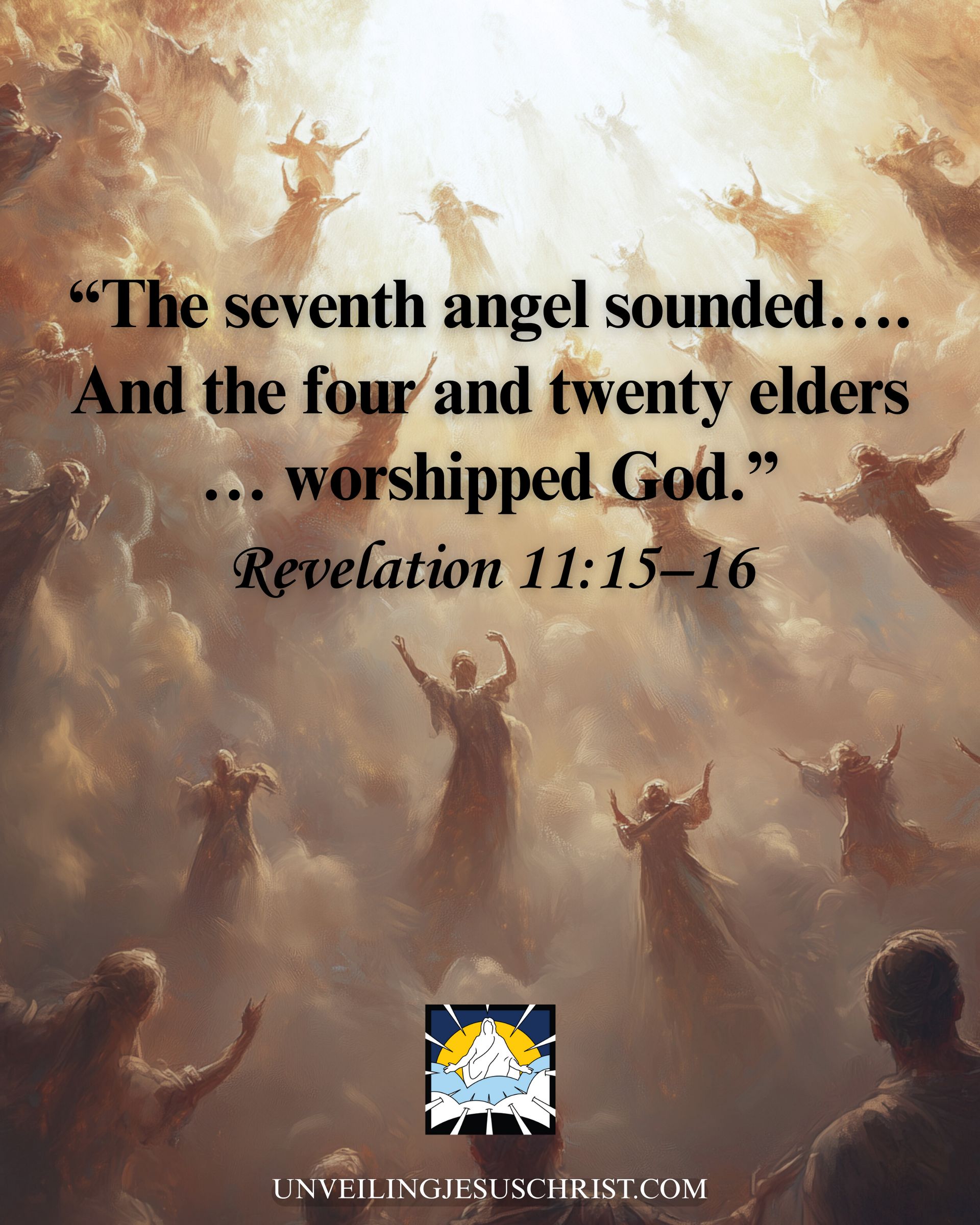
The 24 Elders in Revelation 11:16–17 represent exaltation-worthy saints as of the Second Coming.
They prostrate themselves in solemn worship, saying:
| “We give thee thanks, O Lord God Almighty … because thou hast taken to thee thy great power, and hast reigned.” Revelation 11:16–17 |
These saints rejoice because they will escape the plagues of the Third Woe. They will be taken up to stand with Christ on Mount Zion at the end of the Second Woe, before the plagues of the Third Woe. (Revelation 14:14–16)
Doctrine and Covenants 88:96–97 also describes them:
| “The saints that are upon the earth, who are alive, shall be quickened and be caught up to meet him. And they who have slept in their graves shall come forth, for their graves shall be opened; and they also shall be caught up to meet him in the midst of the pillar of heaven.” Doctrine and Covenants 88:96–97 |
The 24 Elders praise Christ in the prophetic past tense: “hast taken … hast reigned.” His future reign on earth is so certain that John describes it as a present reality, not merely a future hope.
Learn More
For more on John’s introduction to the Third Woe, listen to my podcasts from:
🎧 August 31 – Click here to listen.
🎧 September 2, 2025 – Click here to listen
(Also available wherever you get your podcasts 🎧)
John Cassinat
Unveiling Jesus Christ
Reply